
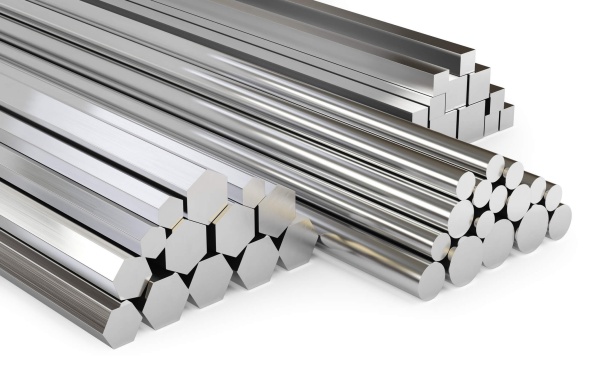
4140 alloy steel is a medium carbon low alloy structural steel, which belongs to the chromium-molybdenum steel series. It belongs to the chromium-molybdenum steel series in the AISI (American Iron and Steel Institute) and SAE (Society of Automotive Engineers) standard system. It is widely used in various industrial fields due to its good comprehensive mechanical properties and processing properties.

How is 4140 Alloy Steel Made?
The manufacturing process of 4140 alloy steel usually starts with high-quality iron ore or scrap steel, which is smelted into molten steel through an electric arc furnace (EAF) or a basic oxygen furnace (BOF), and alloying elements such as carbon, chromium, manganese, and molybdenum are added in specific proportions during the refining process. Subsequently, the molten steel is refined and degassed to remove impurities, and poured into ingots or continuously cast. After cooling, 4140 steel will be obtained into the desired shape (such as bars, plates or tubes) through hot processing methods such as forging and rolling, and finally heat treated (such as quenching and tempering) according to the application to optimize its strength and toughness.
4140 Alloy Steel Chemical Composition
| CHEMICAL | C | Mn | P | S | Si | Ni | Cr | Mo | Cu |
| AISI 4140 | 0.38-0.43 | 0.75-1 | 0.035MAX | 0.04MAX | 0.15-0.35 | 0.25MAX | 0.8-1.1 | 0.15-0.25 | 0.35MAX |
4140 Alloy Steel Physical Properties
| Properties | Metric | Imperial |
| Density | 7.85 g/cm3 | 0.284 lb/in³ |
| Melting point | 1416°C | 2580°F |
4140 Alloy Steel Mechanical Properties
| Properties | Metric | Imperial |
| Tensile strength | 655 MPa | 95000 psi |
| Yield strength | 415 MPa | 60200 psi |
| Bulk modulus (typical for steel) | 140 GPa | 20300 ksi |
| Shear modulus (typical for steel) | 80 GPa | 11600 ksi |
| Elastic modulus | 190-210 GPa | 27557-30458 ksi |
| Poisson’s ratio | 0.27-0.30 | 0.27-0.30 |
| Elongation at break (in 50 mm) | 25.70% | 25.70% |
| Hardness, Brinell | 197 | 197 |
| Hardness, Knoop (converted from Brinell hardness) | 219 | 219 |
| Hardness, Rockwell B (converted from Brinell hardness) | 92 | 92 |
| Hardness, Rockwell C (converted from Brinell hardness. Value below normal HRC range, for comparison purposes only) | 13 | 13 |
| Hardness, Vickers (converted from Brinell hardness) | 207 | 207 |
| Machinability (based on AISI 1212 as 100 machinability) | 65 | 65 |
Thermal Properties of UNS G41400 Alloy Steel
| Properties | Metric | Imperial |
| Thermal expansion coefficient (@ 0-100°C/32-212°F) | 12.2 µm/m°C | 6.78 µin/in°F |
| Thermal conductivity (@ 100°C) | 42.6 W/mK | 296 BTU in/hr.ft².°F |
4140 Alloy Steel Equivalent
| ASTM/AISI | UNS | JIS | KS | ISO | DIN | W-Nr. | NF EN/NF | EN |
| 4140 | G41400 | SCM440 | SCM440 | 42CrMo4 | 42CrMo4 | 1.7225 | 42CD4 | 42CrMo4 |
Common Forms of 4140 Material?
- 4140 Steel Bars
These are cold drawn in the annealed condition. These bars have high hardenability, good hardness penetration and high strength.
- 4140 Bar Stock
4140 bars are round, oil-quenched bars in sizes 6-120 mm. These bars have high strength, wear resistance, toughness and good ductility.
- 4140 Tubing
4140 Tube is suitable for general purpose high toughness and tensile strength applications.
- 4140 Sheet
Cold rolled 4140-10mm thick sheets have high hardness and toughness.
AISI 4140 Alloy Steel Heat Treatment
4140 alloy steel is a type of steel that is very suitable for heat treatment to optimize performance. Common heat treatment processes include:
Normalizing: Eliminate internal stress, improve structure and grain refinement, and prepare for subsequent heat treatment.
Annealing: Reduce hardness, improve machinability, and eliminate internal stress. Usually performed before or during processing.
Quenching: Rapidly cool the steel after heating it to the austenitizing temperature to obtain a martensitic structure, which significantly improves hardness and strength.
Tempering: Tempering must be performed after quenching to reduce brittleness, eliminate internal stress, and adjust to the required strength and toughness combination. The choice of tempering temperature is critical, and different tempering temperatures will result in different final properties.
Weldability and Machinability of 4140 Steel
4140 steel is easy to machine, especially in the annealed state. Therefore, you can use drills, lathes or milling machines to manufacture precision parts such as drill collars, gears, shafts, bolts, piston rods and axles, all of which need to withstand high stresses. It is a good choice for manufacturing complex components because it minimizes tool wear and speeds up the production process. SAE 4140 alloy steel can be welded using all conventional techniques. However, welding this steel in the heat-treated state will affect its mechanical properties and post-weld heat treatment should be performed.
4140 Alloy Steel—Advantages and Disadvantages
✅ Advantages of 4140 alloy steel
1. High strength and high hardness
After heat treatment, 4140 steel has extremely high yield strength and tensile strength, suitable for heavy loads and high impact.
2. Excellent wear resistance
Contains alloy elements such as chromium and molybdenum, has excellent wear resistance, and is suitable for high wear conditions.
3. Good fatigue resistance
Stable performance under long-term stress or alternating load conditions, suitable for manufacturing key components such as gears, shafts, crankshafts, etc.
4. Good heat treatability
Can adjust hardness and toughness through processes such as quenching and tempering to meet different mechanical performance requirements.
5. Good machinability
Good machinability before heat treatment, suitable for conventional machining processes such as turning, milling, and drilling.
❌ Disadvantages of 4140 alloy steel
- General welding performance
High carbon content, preheating before welding and heat treatment after welding are required, otherwise cracks are likely to occur.
- Poor corrosion resistance
No natural antioxidant ability, additional protection is required when exposed in a humid or corrosive environment.
- Higher cost than ordinary carbon steel
Contains more alloying elements, and the production and heat treatment costs are relatively high.
- Heat treatment needs to be strictly controlled
Improper heat treatment may lead to embrittlement of the structure or degradation of performance, and professional control of process parameters is required.
Typical Application
Machinery manufacturing
Gear and shaft parts
Hydraulic and pneumatic parts
Aerospace and defense
Engine parts
Petroleum and energy industry
Drilling and mining equipment
Power generation equipment
Automobile and rail transportation
Tool and mold manufacturing
High-strength tools
Ship and marine engineering
Agricultural machinery
FAQ
1. What is 4140 steel good for?
4140 alloy steel is good for demanding applications such as gears, shafts and suspensions that require high wear resistance.
2. What is 4140 alloy equivalent to?
4140 alloy steel has many other names and in other material standards it is equivalent to AISI 4140, DIN 1.7225, 42CrMo4, EN 19 and JIS SCM440.
3. Is 4140 considered stainless steel?
For any steel to be considered stainless steel, it needs to have a chromium content of at least 10.5%. 4140 alloy steel is not stainless steel as it contains about 1% chromium.
4. What grade of steel is 4140?
4140 is a grade classification and 4140 falls into the category of molybdenum-chromium alloy steel.